
• Call: +62
  • E-mail: sahita.institute@hints.id
Sahita Institure
  • Home
  • About Us
  • Campaign
    • Trade Justice
    • Digital Justice
    • Energy Transtition
  • Collective Idea
    • Visual Movement
    • Article
  • News
  • Publication
No Result
View All Result
Sahita Institute
No Result
View All Result

IPEF is only to save US corporations from crisis while continue to eliminate people’s rights

January 30, 2024
in Campaign, Trade Justice
Home Campaign
Share on FacebookShare on Twitter

Press Release
Responding to IPEF Negotiation Round
15 March 2023
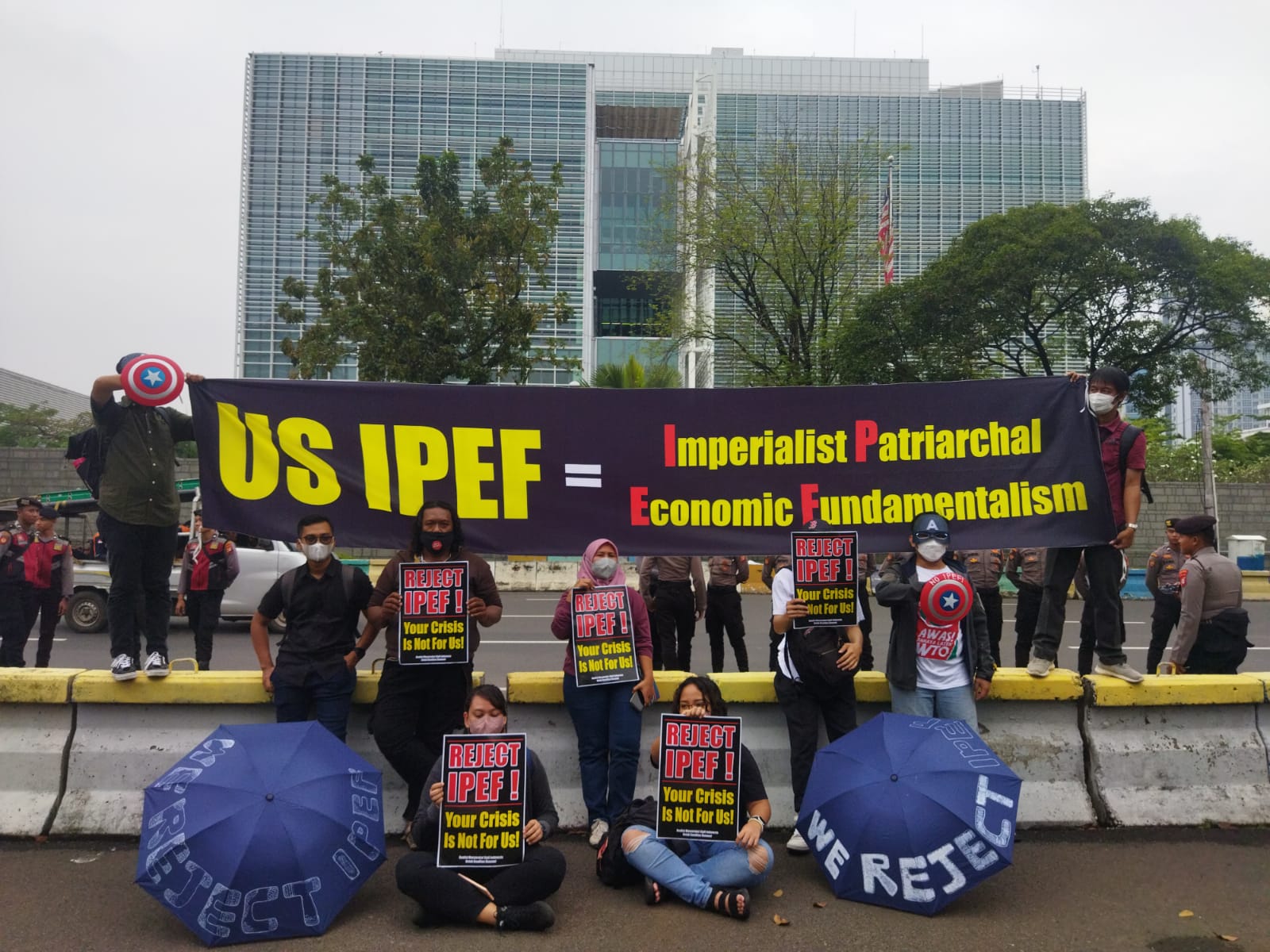
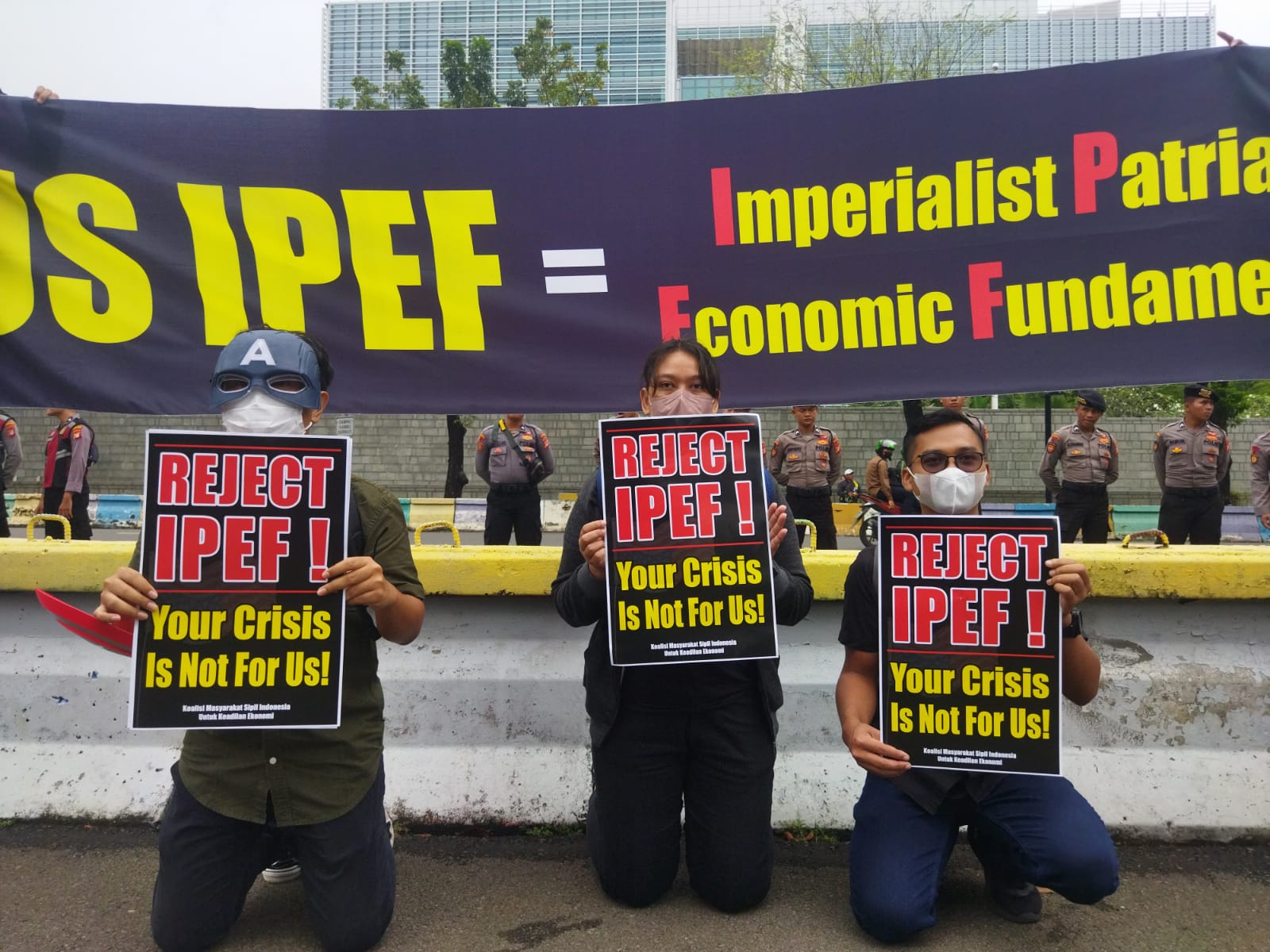
Jakarta, 15 March 2023. Indonesian Civil Society Coalition for Economic Justice held a protest today in front of the US Embassy in Jakarta to express its rejection of the Indo-Pacific Economic Framework (IPEF). In the midst of the global economic crisis, the United States is trying to rebuild its national industrialisation with a less open free trade agreement and push for policy harmonisation based on US standards. The IPEF will hold its second round of negotiations in Bali from 13-19 March 2023.

IPEF was initiated by the United States in September 2022 as a new model of regional free trade agreement involving 13 other partner countries.  The IPEF includes four pillars: (1) trade; (2) supply chain; (3) clean energy, decarbonisation, and infrastructure; and (4) taxation and anti-corruption.  The US government is targeting the completion of the negotiations this year to coincide with the APEC Summit to be held in San Francisco in November 2023. 

Director of Indonesia for Global Justice, Rahmat Maulana Sidik emphasised that the IPEF negotiation process was led by the US, including the drafting of the agreement text, in a closed manner. “With the short period of time and the closed draft text of the agreement to the public, it is certain that there is no meaningful participation by partner countries to provide their input in this agreement process. Moreover, to analyse the social, environmental, and gender impacts that will potentially arise,” he said. US domination of the IPEF process was also exercised through deciding the location for the negotiation rounds and the involvement of US-based multinational companies in the hearing process.

Kartini Samon of GRAIN stated that the Biden administration manoeuvred to avoid debate and resistance from the US Congress by not including market access provisions or tariff reductions and avoiding changes to domestic laws. Following the launch of the IPEF, the US Government released a report containing a priority list for the reduction of non-tariff barriers that will be promoted through the IPEF through the harmonisation of a number of policies and regulations that are seen as technical barriers to trade with the United States. “For Indonesia itself, this policy harmonisation effort through IPEF can cause problems and widespread impacts. In the agricultural sector, for example, efforts to harmonise technical barriers to trade could oblige Indonesia to relax domestic regulations related to the commercialisation and import of genetically modified seeds and food products. This, of course, would greatly benefit the US, which hosts a number of giant producers of genetically modified products. Besides the provisions related to genetically modified products, another rule that is seen as a technical barrier that will be pushed for harmonisation is the mandatory halal certification for imports of livestock products, considering that only 3 out of 14 IPEF member countries have this obligation; Brunei, Malaysia and Indonesia. Harmonisation of halal certification could directly affect livestock farmers and abattoirs as well as consumers in Indonesia,” said Kartini Samon.

Meanwhile, Arie Kurniawaty representing Solidaritas Perempuan stated that IPEF will be the first mega-regional economic agreement for the US, involving 40% of the world’s GDP will produce new rules, processes and commitments that to secure US trade and investment interests to offset China’s dominance, political and military influence in the Asia-Pacific region. “The IPEF is not, and will never be, just about economic trade. Rather, it is a chain of hegemonic power domination for the US, it is like a continuation of the cold war that always harms the sovereignty of nations and the human rights of Asian women and people as developing countries.” she said.  

IPEF uses language that seems to be in favour and good for the interests of sustainable development, such as clean energy being one of the pillars. In fact, this provision is only used by the US to strengthen US domestic industrial development related to the production of green technology for energy transition. Rachmi Hertanti from Transnational Institute stated “The US wants to keep pace with China to become a major player in the production of green technology for energy transition. It is highly unlikely that IPEF will bring US investment into Indonesia to support Indonesia’s industrial downstream agenda. And this precludes Indonesia from benefiting from this co-operation. As a result, the IPEF will only contradict Indonesia’s national interests.

Marthin Hadiwinata from Ekomarin closed with the statement that the fisheries sector in the trade pillar discussed in the IPEF will regulate the prohibition of subsidies in the sector. The rationale for this is that subsidies are considered to encourage uncontrolled exploitation of fisheries resources. Therefore, Indonesia’s domestic regulations that still provide subsidies will be intervened. “The majority of fisherfolks in Indonesia are small and medium scale. Removal of subsidies in the fisheries sector will clearly hamper Indonesian fisherfolks. This will be an obstacle for developing countries like Indonesia to maintain domestic rules, which has also been done in the WTO reform negotiations,” he said.

Contacts for further information:

Arie Kurniawaty – Solidaritas Perempuan,
+62 812 8056 4651

Rahmat Maulana Sidik – Indonesia for Global Justice
+62 812 0025 135

Previous Post

Series Activities : Respon to US-IPEF

Next Post

Sahita Institute Oral Intervention at the 2nd round of Indo-Pacific Economic Framework (IPEF) negotiations

admin_hints

admin_hints

Discussion about this post

Follow Us

  • Mulai dari Invasi Teluk Babi Kuba, Afganistan, Irak, Libya, kini Venezuela. Amerika Serikat melakukan invasi/terorisme negara atas nama keamanan nasional.

Konsep kedaulatan negara (Westphalian Sovereignty) resmi jadi sampah. Batas negara dianggap tidak ada. Hukum Amerika berlaku di seluruh dunia. Ekstrateritorial. Sesuai kehendaknya sendiri. Dengan cita-cita membangun Imperialisme Amerika Serikat.

Invasi kali ini dibingkai dengan "Penegakan Hukum" kasus narkotika yang didalangi oleh Presiden Venezuela yakni Nicolas Maduro  seperti yang dituduhkan oleh Trump.

Terorisme terhadap kedaulatan negara yang dilakukan Amerika Serikat harus dikecam dan dihentikan. Salah satu caranya dengan membangun kekuatan politik negara Selatan-Selatan. Bukan cara yang mudah tentunya, tapi bukan berarti tidak bisa dilakukan, dan itu bisa dimulai dari persatuan gerakan rakyat antar negara.
  • Selamat Hari Raya Natal 2025 dan Tahun Baru 2026.

Melewati tahun ini yang penuh perjuangan dengan Cinta Kasih dan Solidaritas sesama warga.

Salam buat semua kawan dan keluarga yang merayakan.
  • Bagaimana negosiasi tarif Trump dan FTA memengaruhi aturan hukum dan ekonomi Indonesia?

Koalisi MKE bersama LCITI dan FHUI mengadakan Focus Group Discussion untuk membahas dampak tarif, langkah negosiasi pemerintah, serta pentingnya menjalankan Putusan MK No. 13/PUU-XVI/2018 sebagai kontrol publik atas perjanjian internasional.

📅 Kamis, 27 November 2025
🕘 09.30 – 17.00 WIB
📍 Fakultas Hukum Universitas Indonesia, Ruang Rapat Guru Besar

Diskusi ini menjadi ruang penting bagi masyarakat sipil untuk menilai transparansi dan akuntabilitas kebijakan perdagangan Indonesia di tengah tekanan global.
  • Hilirisasi industri menjadi agenda kunci yang diteruskan oleh Pemerintahan Prabowo. Agenda ini kerap kali diklaim menjadi jalan untuk pertumbuhan ekonomi dan upaya keluar dari jeratan ketergantungan ekspor bahan mentah. 

Sayangnya hilirisasi yang dikontrol oleh investasi besar tidak diimplementasikan berdasarkan kebutuhan rakyat. Agenda hilirisasi justru masuk pada replikasi pola ketimpangan lama mulai dari ketergantungan modal asing, eksploitasi sumber daya alam skala besar, dan marjinalisasi komunitas. 

Realitas tersebut tentunya jauh dari upaya mencapai transisi berkeadilan. Transisi berkeadilan mengacu pada serangkaian prinsip, proses, dan praktik untuk mencapai tansformasi struktural yang holistik. Gagasan transisi berkeadilan dibangun berdasarkan pemikiran dan pengalaman gerakan lingkungan, masyarakat adat dan buruh yang menggarisbawahi pentingnya aspek lingkungan dan sosioekonomi dalam memperjuangkan keadilan iklim dan lingkungan.
  • DISKUSI PUBLIK: “Menelisik Pemerintahan Kelima Pasca Reformasi”

Selain sebagai ruang refleksi, kegiatan ini juga dimaksudkan untuk mempererat silaturahmi antar organisasi gerakan sosial dalam suasana yang baru, sekaligus membuka peluang kolaborasi yang sinergis untuk menjawab tantangan zaman. Oleh karena itu, diskusi publik ini diselenggarakan sebagai sebuah platform untuk membedah situasi terkini, merumuskan peluang, dan menyusun langkah-langkah strategis gerakan sosial.
  • Unpacking the ASEAN-Canada Free Trade Agreement (ACAFTA): Risk and Threats of Investor Lawsuit to State for People, Environment, and Democracy

ASEAN and Canada are currently negotiating ASEAN - Canada Free Trade Agreement (ACAFTA). This agreement is central for Canada to respond the current geopolitical situation, particularly in relation to competition for securing access to critical minerals.

One of key concerns of CSOs and Communities is the inclusion of the Investor-State Dispute Settlement (ISDS) mechanism which has repeatedly been used by multinational corporations to sue governments over public interest policies including the ones aimed at protecting the environment, indigenous rights, and public health.

In light of this concern, there is a pressing need to raise awareness and build capacity among civil society organizations and grassroots communities across ASEAN and Canada to critically discuss and examine the ACAFTA process and content.

Indonesia CSO Coalition for Economic Justice, Focus on the Global South, FTA Watch Thailand, Third World Network, AFTINET, Transnational Institute, and Canadian Centre for Policy Alternatives are hosting the webinar on:

Date: Thursday, 30 October 2025
Time: 19:00-21:00 Jakarta/Bangkok | 20:00-22:00 Malaysia/Manila | 08:00-10:00 Ottawa

Please register via bit.ly/AseanCanadaWebinar. Interpretation will be available in Indonesian and Thai.
  • Dunia sedang mengalami perubahan besar dalam konstelasi ekonomi-politik global. Ini ditandai dengan kemunduran relatif AS sebagai kekuatan imperialis utama bersama mitra strategisnya di Barat, perlambatan ekonomi kapitalis sejak krisis Keuangan Besar 2008–yang diperparah dengan pandemi covid-19, dan munculnya kekuatan-kekuatan alternatif seperti Tiongkok, Rusia, dan negara-negara lain yang disebut sebagai ‘penguatan’ Global South dengan visi yang condong mengarah pada tatanan dunia multipolar. Tentu, terlalu dini untuk mendeklarasikan kekalahan AS dan  Barat di saat kekuatan tersebut masih memegang kendali kuat pada bidang militer dan teknologi. 

Begitu pula perang tarif yang dilancarkan oleh Donald Trump perlu dipertimbangkan sebagai tujuan imperialis AS untuk menegaskan kembali  kekuatannya. Akan tetapi, kebangkitan kekuatan Global South tidak bisa diremehkan, mengingat rata-rata pertumbuhan ekonomi negara-negara tersebut mencerminkan kemampuan mereka sebagai pemain penting dalam percaturan ekonomi-politik global.

Perubahan besar memicu perdebatan tentang arah masa depan tatanan dunia. Dalam konteks ini, multipolaritas yang diaspirasikan Global South sering dipandang sebagai peluang untuk membuat tatanan global yang lebih demokratis. Inisiatif seperti BRICS+ dan OPEC+, kerjasama ekonomi Selatan-Selatan, serta diplomasi energi dan pangan menjadi sinyal dari upaya negara-negara periferi untuk membangun tatanan yang lebih setara. Namun, pertanyaan penting muncul: apakah ini benar-benar menjanjikan pembebasan, atau hanya mengganti wajah kekuasaan global yang tetap bersifat eksploitatif? Dalam praktiknya, kerja sama ini kerap tidak lepas dari kepentingan elite negara dan korporasi besar, serta belum sepenuhnya mengakar pada gerakan rakyat yang sejati.

Dalam waktu yang sama, imperialisme global juga ikut menyesuaikan dirinya. Salah satu wajah barunya adalah melalui apa yang disebut sebagai green colonialism — yakni kolonialisasi dalam bentuk menggunakan proyek-proyek transisi energi "hijau" yang dibaliknya justru memperparah perampasan tanah, penggusuran masyarakat adat, dan pencaplokan sumber daya alam oleh perusahaan.
  • Sering mendengar pepatah "Jangan tanyakan apa yang negara berikan padamu, tapi tanyakan apa yang negara (Pemerintah Indonesia) berikan kepada Paman Sam...😁"

Negeri kita sejak dahulu terkenal dengan budaya ramah tamahnya, kali ini kembali terbukti dengan keramahannya kepada Investasi asing dalam hal ini Amerika Serikat.

Say good bye to "TKDN"

© 2022 - Sahita Institute

  • Facebook
  • Twitter
  • Instagram
No Result
View All Result
  • Home
  • About Us
  • Campaign
    • Trade Justice
    • Digital Justice
    • Energy Transtition
  • Collective Idea
    • Visual Movement
    • Article
  • News
  • Publication

© 2022 Sahita Institute