
Authors: A.Taylor (TNI), Aryanto Nugroho (PWYP Indonesia), Rachmi Hertanti (TNI), Salsabila Aziziah (Puanifesto-MKE Coalition), Sam Cossar Gilbert (FoE International)
Co-publishers: Transnational Institute (TNI), Focus on the Global South, Third World Network (TWN), Australian Fair Trade & Investment Network (AFTINET), PWYP INDONESIA, LCITI-UI, SAHITA INSTITUTE (Hints), Friends of the Earth (FoE) Asia Pacific, Bilaterals.org, Pacific Network on Globalisation (PANG)
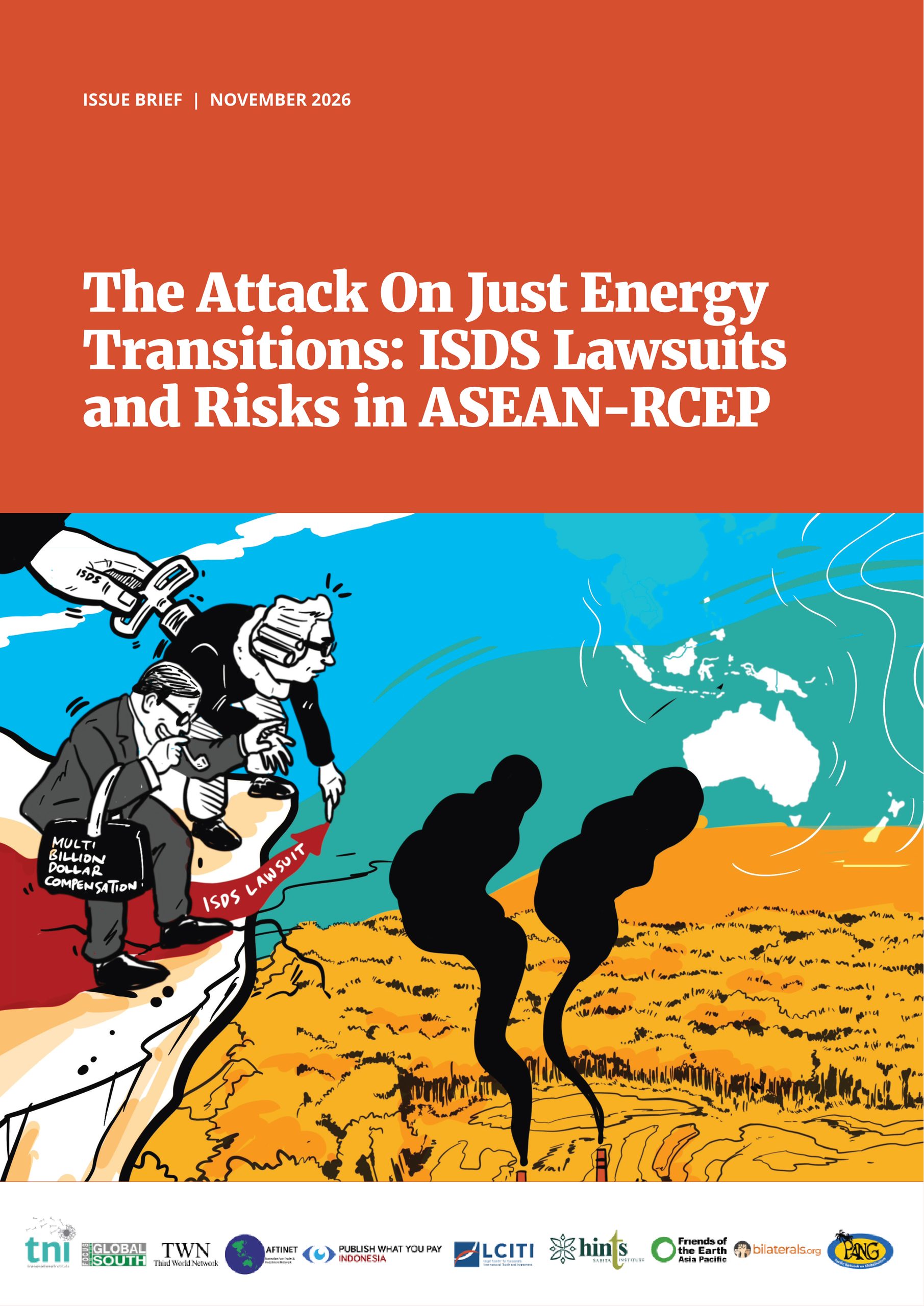
The Investor-State Dispute Settlement (ISDS) mechanism in trade and investment agreements enables foreign investors to sue governments for billions of dollars if they deem that a change in law or policy or a court decision reduces their future profits. Fossil fuel companies are increasingly using ISDS against government attempts to phase out fossil fuels, making ISDS a barrier to a just transition towards renewable non-carbon-based energy.
ISDS claims have become a significant obstacle to achieving a just energy transition on a global scale. The 2025 UNCTAD Report notes an upward trend in ISDS cases throughout 2024 relating to mineral-extraction and energy-supply activities. By the end of 2024, there were at least 249 cases relating to the energy and mining sectors.
ISDS is outdated and governments are rejecting it. United Nations (UN) bodies and other multilateral institutions have identified ISDS as a structural barrier to achieving climate justice and a just energy transition. There is no other way to stop these corporate attacks on a just energy transition and climate justice other than removing ISDS from trade and investment agreements.
This report identifies the ISDS threat to ASEAN-RCEP countries. ASEAN-RCEP member states have a ‘traditional’ network of old-generation investment treaties covering 85% of their foreign direct investment (FDI), which may expose them to a higher risk of ISDS claims. The region is facing increasing pressure to strengthen investment liberalization and predictability through trade and investment agreements with foreign partners particularly when these countries have attracted more investments from industrialized economies in green technology and renewable energy for energy transition.
There are four areas of concern regarding ISDS claims that may hinder the efforts of ASEAN-RCEP governments in addressing the climate crisis and pursuing a just energy transition. These include: potential implications for net-zero emission commitments; environmental implications; concerns regarding national sovereignty over natural resources; and potential impacts on public budgets and the financing of the energy transition.
Currently, ASEAN maintains several agreements that specifically govern investment protection through an Investor-State Dispute Settlement (ISDS) mechanism—including the ASEAN Comprehensive Investment Agreement (ACIA), as well as investment agreements with South Korea, China, Japan, India, and the ASEAN-Australia-New Zealand Free Trade Area (AANZFTA). Yet, to date, there has been no initiative at the ASEAN level to revise these investment and trade agreements, which contain chapters dedicated to investment protection.
However, the ASEAN Investment Report 2024 has called for urgent reform of these investment agreements. The rationale is that most of ASEAN’s older-generation investment agreements are misaligned with energy transition goals, as they lack provisions that proactively support low-carbon energy investments. The investment chapter in the Regional Comprehensive Economic Partnership (RCEP) does not currently include ISDS. But the parties committed to revisit that omission through a General Review are due to make a decision on whether and how to adopt an ISDS mechanism by around 2027. A nearer-term test of the same question is already underway. The review of the ASEAN-Australia-New Zealand free trade agreement (AANZFTA) is ongoing (2026) and requires consensus among the ten ASEAN countries plus Australia and New Zealand to remove or amend ISDS in the updated agreement.
Finally, it is essential to hold ASEAN leaders to a serious commitment to review these free trade agreements—with the aim of eliminating the ISDS mechanism—as a step toward realizing a just green transition within the region.


